
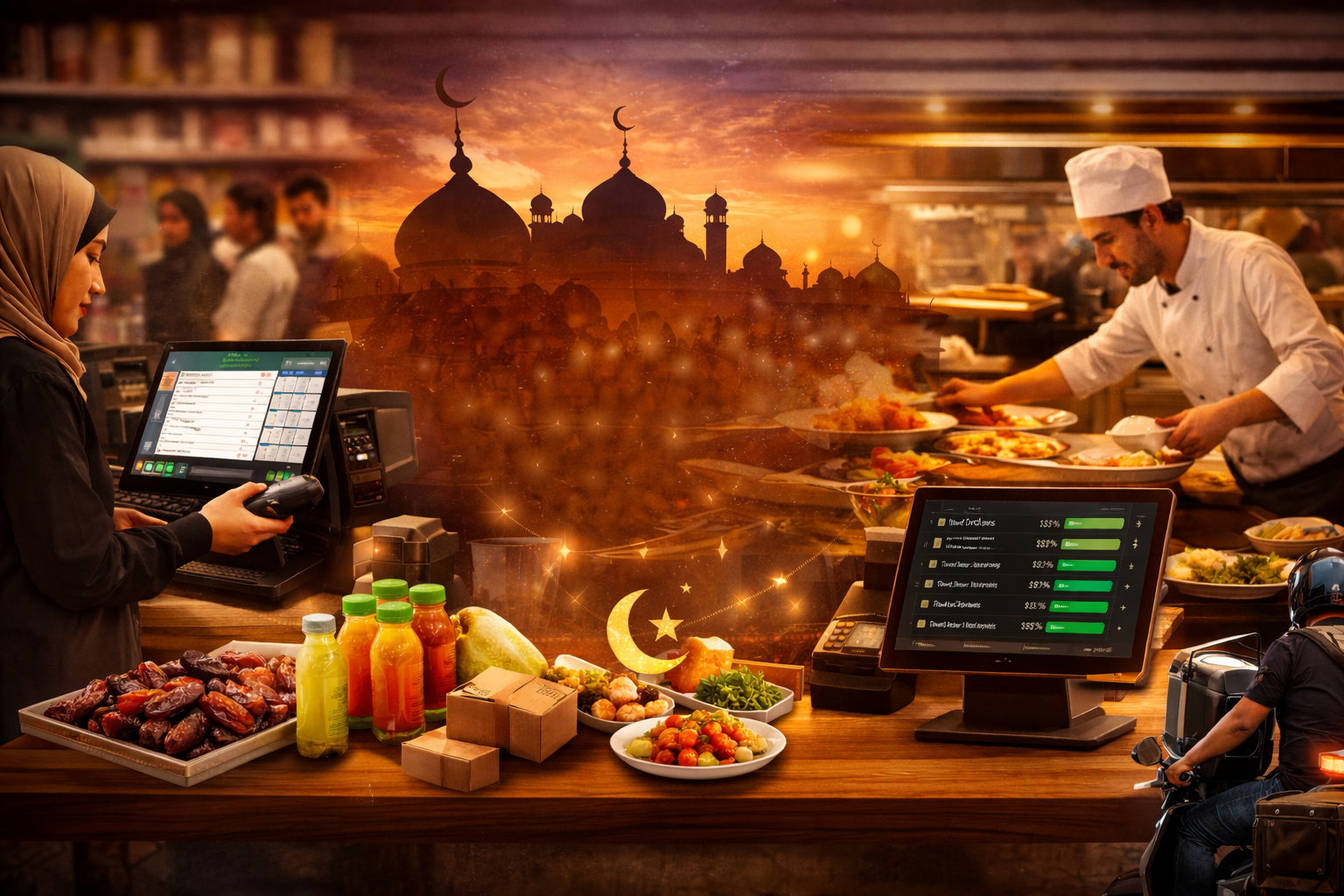
Ramadan changes how customers buy. In the GCC, grocery baskets get bigger before Iftar, restaurants experience intense reservation and takeaway spikes, and retail stores stay busy late into the night. For business owners, it’s a high-opportunity season but only if operations stay smooth when demand peaks.
Here’s a common Ramadan story. It’s 5:20 PM. Your team is moving fast. A customer asks for a price check. Another wants to split payments. A popular item is suddenly out of stock. The queue grows. The kitchen is waiting on a modification. One small delay triggers a chain reaction.
The difference between a profitable Ramadan and a stressful one often comes down to one thing: integration. When your POS, inventory, ordering, reporting, and integrations work together in real time, you can handle the rush confidently without sacrificing customer experience.
Why Ramadan Rush Feels Different (and Why Systems Get Exposed)
Ramadan is not just “more customers.” It’s peak demand concentrated into specific windows especially the hour before Iftar and late-night shopping after Taraweeh. That pressure exposes weak processes and disconnected tools.
- Queues grow faster than counters can process
- Stockouts happen on fast-moving Ramadan items
- Kitchen coordination becomes chaotic during bulk orders
- Promotions get applied inconsistently
- Managers lose visibility across branches
With an integrated solution from iPOS, you can connect front-of-house and back-office operations so your team spends less time fixing issues and more time serving customers.
1) Speed Up Checkout Before Iftar with a High-Performance POS
The final hour before Iftar is where performance matters most. A fast POS experience reduces queue length, improves customer flow, and protects sales during the busiest period.
With iPOS Retail and iPOS Restaurant, businesses can handle high-volume transactions efficiently with practical POS features that support peak-hour operations.
- Fast item lookup and quick billing workflows
- Barcode scanning support for grocery and retail speed
- Multiple counter billing for peak traffic management
- Smoother payment handling to reduce checkout delays
When checkout stays fast, customers don’t abandon carts and your staff doesn’t burn out trying to catch up.
2) Prevent Stockouts with Real-Time Ramadan Inventory Control
Ramadan demand is predictable: dates, juices, rice, essentials, iftar packs, and fast-moving seasonal items. The risk is not demand it’s running out at the worst possible time.
Integrated inventory management helps you track what’s selling, what’s about to run out, and what needs replenishment without waiting for end-of-day reconciliation.
- Real-time stock tracking while billing happens
- Better visibility into fast-moving items
- Fewer manual errors and mismatches
- Smarter replenishment planning during peak weeks
This is especially useful for businesses like supermarkets and groceries, where peak-hour demand can wipe out entire categories quickly.
3) Keep Restaurants Organized During Iftar, Takeaway, and Delivery Spikes
Restaurants face a different Ramadan rush: reservations, group orders, meal modifications, and simultaneous dine-in + takeaway pressure. Without a connected workflow, order errors increase and the kitchen gets overloaded.
An integrated restaurant setup helps align the counter, wait staff, and kitchen especially during full-capacity Iftar service and late-night Suhoor orders.
Businesses running cafés and quick-service concepts often feel this most. If you operate a café, cloud kitchen, or mobile concept, this matters even more during short peak windows. See iPOS solutions for coffee shops and coffee shops and food trucks.
- Better order flow between front-of-house and kitchen
- Reduced order duplication and missed items
- Faster handling of high-volume takeaway periods
- More consistent service during peak bookings
For restaurants, the goal is simple: serve more customers per hour without compromising accuracy.
4) Run Ramadan Promotions and Combos Without Billing Confusion
Ramadan is promotion season: Iftar bundles, family packs, limited-time offers, and category discounts. The challenge is applying them consistently across counters and branches especially when the queue is long.
With an integrated system, you can run Ramadan campaigns with less manual effort and fewer mistakes at the counter.
- More consistent promotion application at checkout
- Better tracking of what offers actually drive revenue
- Cleaner reporting to understand margins on bundles
This is particularly important for high-variation retail categories like garments and footwear stores and fashion and beauty stores, where pricing, bundles, and seasonal offers change frequently.
5) Manage Multi-Branch Operations with Central Visibility
If you operate multiple stores, Ramadan can amplify inconsistencies: one branch runs out of key items, another applies offers differently, and managers lose visibility into what’s happening in real time.
An integrated solution helps you centralize oversight and standardize operations across branches especially during the most critical sales windows.
- Better visibility across outlets during peak hours
- More consistent pricing and promotion control
- Consolidated reporting for faster decision-making
When branches follow one connected system, you reduce the “branch-by-branch firefighting” that Ramadan often creates.
6) Connect iPOS with ERP, eCommerce, and Compliance Integrations
Ramadan pressure doesn’t stop at the counter. The back office also gets busy purchasing, accounting, ERP posting, eCommerce orders, and compliance requirements. Integration becomes critical when volume rises.
iPOS supports integrations that help businesses keep operations connected across systems:
- SAP integration
- Oracle NetSuite integration
- Microsoft Dynamics 365 integration
- Zoho integration
- QuickBooks integration
- Shopify integration
- WooCommerce integration
- ZATCA integration
- Oracle OPERA PMS integration
When sales rise, integrations reduce manual workload and keep data consistent across departments especially for finance, inventory, and online orders.
A Practical Ramadan Preparation Checklist
If you want to avoid operational stress during Ramadan, planning early makes a measurable difference. Here’s a practical checklist many businesses follow:
- Identify your top Ramadan-selling items and ensure adequate stock coverage
- Set up your Ramadan pricing, bundles, and promotions in advance
- Ensure all billing counters and devices are configured and tested
- Train staff on fast workflows for peak-hour operations
- Confirm integrations are working (ERP, accounting, eCommerce, compliance)
- Review sales reports daily to adapt quickly during the month
Final Thoughts: Don’t Just Survive the Ramadan Rush Control It
Ramadan is one of the most valuable seasons for retail and restaurants in the GCC. But the businesses that win are the ones that run faster, smarter, and more consistently under pressure.
With an integrated solution from iPOS built for both retail and restaurant operations you can reduce queues, prevent stockouts, streamline kitchen workflows, run promotions confidently, and keep management visibility across branches.
Explore the core solutions here: